
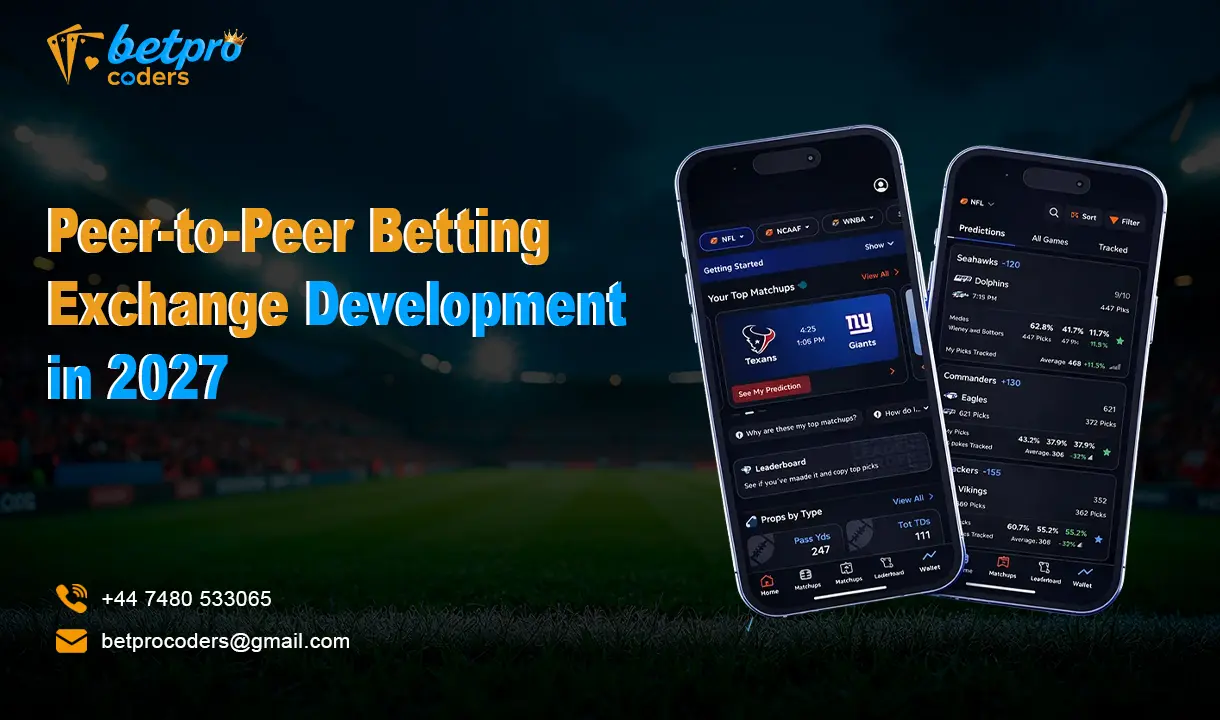
A peer-to-peer betting app lets users bet against each other instead of against the house. Heading into 2027, this model has moved from niche to mainstream. US platforms like ProphetX and Novig received federal approval as regulated exchanges, and brokers like Vodds keep pulling sharp bettors away from traditional sportsbooks. For operators and startups, that creates a clear opportunity: build a betting exchange that charges a small commission, carries no outcome risk, and offers users better odds than any bookmaker.
This guide explains how a peer-to-peer betting exchange works, how platforms like Novig, ProphetX, and Vodds differ, and what it takes to build one. We cover the matching engine, order book, tech stack, liquidity, licensing, development process & cost.
What Is a Peer-to-Peer Betting App? Betting Exchange vs Sportsbook
A peer-to-peer betting app is a platform where one user’s bet is matched with another user who holds the opposite view. If you think Manchester City will win, someone else on the platform takes the position that they won’t. The operator does not take a side. It simply matches the two orders, holds the funds, and settles the result.
That is the key difference between a p2p betting exchange and a traditional sportsbook:
| Factor | Traditional Sportsbook | Peer to Peer Betting Exchange |
|---|---|---|
| Who sets the odds | The bookmaker | Users, through supply and demand |
| Who you bet against | The house | Other users |
| Revenue model | Margin (vig) built into odds | Commission on net winnings or trades |
| Operator risk | High, the book can lose | Low, bets are matched |
| Winning customers | Often limited or banned | Welcome, they add liquidity |
| Bet types | Back only | Back and lay |
Because the exchange does not need to protect a book, it can offer tighter prices. Users get better odds, sharp bettors are not restricted, and the operator earns steady fees on volume. This is why betting exchange app development has become one of the most requested projects in iGaming.
Read more: Types of Sports Betting Platforms You Should Know in 2027
Why Betting Exchanges and Prediction Markets Are Trending in 2027
2026 was the breakout year for exchange-style betting, especially in the United States, and the momentum is carrying into 2027. A few developments stand out:
- ProphetX became a federally regulated exchange. The CFTC approved ProphetX as a designated contract market and clearinghouse in June 2026, and it launched sports event contracts nationwide on June 18, 2026. It later raised USD 35 million in August 2026.
- Novig followed days later. Novig, founded in 2021, received its designated contract market approval on June 16, 2026 and launched nationally in August 2026. It markets itself as a no-vig, peer-to-peer sports exchange.
- Prediction markets went mainstream. Event contracts on sports now sit alongside traditional sportsbooks, and many users treat them as the same product with better pricing.
- Bettors want fair odds. Sportsbooks limiting winning players has pushed experienced bettors toward exchanges and brokers that welcome sharp action.
Outside the US, Betfair, Smarkets and Matchbook have proved for years that the exchange model works in regulated markets. Together, these trends show that demand for betting exchange platform development is real and growing.
Vodds vs Betting Exchange vs Prediction Market: Key Differences
Founders often group Novig, ProphetX, and Vodds, but they run on different models. Picking the right one shapes your tech, licensing, and revenue.
| Model | Example | How It Works | How It Earns | Regulation |
|---|---|---|---|---|
| Betting broker | Vodds | Routes bets from one wallet to partner books and exchanges like Pinnacle, Betfair and Matchbook | Spread, rebates, partner deals | Gambling licence (Vodds is Curaçao-licensed) |
| Betting exchange | Betfair, Smarkets | Matches back and lay bets between users in its own order book | Commission on net winnings | Gambling licence (UKGC, MGA, etc.) |
| Sports prediction market | ProphetX, Novig | Users trade event contracts on outcomes in a peer-to-peer order book | Trading fees or commission | CFTC in the US |
Betting broker (the Vodds model)
Vodds, operating since 2016, is not an exchange. It aggregates prices from partner bookmakers and exchanges and places bets on the user’s behalf through a single wallet. A broker needs strong integrations and odds aggregation but no matching engine of its own.
Betting exchange (the Betfair model)
An exchange keeps its own order book. Users back or lay outcomes, and the matching engine pairs compatible orders. This is the purest peer-to-peer betting app model and the most technically demanding.
Prediction market (the ProphetX and Novig model)
A prediction market lists sports event contracts that pay out if an outcome happens. ProphetX uses back-and-lay style trading, while Novig runs an order book with make and take pricing. Under the hood, the matching technology is almost identical to an exchange. The main difference is the regulatory wrapper.
Back and Lay Betting: How the Matching Engine and Order Book Work
Back and lay betting is the core of every exchange. To back means betting that something will happen. To lay means betting that it will not, which is acting as the bookmaker for that bet.
A simple example
User A wants to back Team X at odds of 2.50 for USD 100. User B is willing to lay Team X at 2.50. The matching engine pairs them. If Team X wins, User A receives USD 150 profit from User B’s liability. If Team X loses, User B keeps User A’s USD 100 stake. The exchange takes a commission from the winner’s net profit.
The order book
The order book shows all unmatched back and lay offers for each selection at every price level. Users can either take the best available price instantly or post their own price and wait for someone to match it. This depth of offers is what users see as “available to back” and “available to lay”.
The matching engine
The matching engine is the heart of your exchange betting software. It must:
- Match orders on price-time priority, so the best price and earliest order fill first
- Support partial matching when stake sizes differ
- Calculate liability for lay bets and lock funds instantly
- Handle in-play suspension when goals, wickets or key events happen
- Process thousands of orders per second without errors or double fills
- Keep a full audit trail for regulators and dispute resolution
A slow or buggy matching engine destroys trust fast. This is where custom engineering matters most.
Must-Have Features of a Betting Exchange App
Every successful peer to peer betting app balances two audiences: bettors who want speed and fair prices, and operators who need control over markets, risk and compliance. Here are the features to plan for.
User-side features
- Fast onboarding with built-in KYC verification
- Back and lay ladders with one-tap betting
- Live in-play markets with real-time odds updates
- Cash out and hedge (green up) tools
- Bet history, open positions and profit and loss tracking
- Multiple payment methods, including cards, e-wallets, UPI where permitted, and crypto where licensed
- Responsible gambling tools such as deposit limits, timeouts and self-exclusion
- Push notifications for matched bets, price moves and results
Admin and operator features
- Market creation, suspension and settlement controls
- Commission configuration by market, sport or user tier
- Risk dashboards and exposure monitoring
- Market maker and liquidity provider management
- Fraud detection, AML alerts and account audits
- Affiliate, bonus and promotion management
- Reporting for finance and regulators
Advanced features that win users
- Peer-to-peer parlays and bet builders
- Trading API access for professional and bot traders
- Social features such as leaderboards and shared bets
- AI-based pricing suggestions and personalized market feeds
Tech Stack and Architecture for Exchange Betting Software
A peer to peer betting app behaves more like a financial trading platform than a regular betting app. The architecture needs low latency, strong consistency and high availability.
| Layer | Recommended Technologies |
|---|---|
| Mobile apps | Flutter, React Native, or native Swift and Kotlin |
| Web front end | React, Next.js, TypeScript |
| Matching engine | Go, Rust, C++ or Java for low latency |
| Backend services | Node.js, Go, Java Spring Boot microservices |
| Real-time updates | WebSockets, Kafka, Redis Pub/Sub |
| Databases | PostgreSQL for transactions, Redis for order book cache, ClickHouse for analytics |
| Infrastructure | AWS or GCP, Kubernetes, Docker, CDN |
| Security | OAuth 2.0, encryption at rest and in transit, WAF, DDoS protection |
Core architecture components
- Matching engine service running in memory, with event sourcing for recovery
- Wallet and ledger service using double-entry accounting so every cent is traceable
- Market data service that ingests feeds, fixtures and results
- Settlement service that resolves markets and pays out automatically
- Risk and compliance service for KYC, AML and limits
If you plan to pull external prices or mirror exchange markets, the integration layer matters as much as the engine. Our guide on integrating Betfair data into a real-time sportsbook walks through how streaming data, market IDs and order placement fit into this kind of architecture.
Odds Feeds, Liquidity and Risk Management
Liquidity is the biggest challenge for any new p2p betting exchange. An exchange with empty order books has nothing to offer, no matter how good the app looks. Users arrive, see no prices, and leave.
How new exchanges build liquidity
- Market makers: partner with professional traders or run in-house bots that post prices on both sides
- Liquidity sharing: connect to an established exchange so your users see deep markets from day one. Many operators use Betfair Exchange odds and liquidity integration to fill their books while their own user base grows
- Incentives: commission discounts or rebates for users who post unmatched offers
- Focused markets: launch with a few high-volume sports, such as football, cricket and tennis, before expanding
Odds feeds and data
Even an exchange needs reliable data. You will need fixture feeds, live scores, results for settlement and reference prices for market makers. Choose providers with low latency and strong uptime, since a delayed feed during in-play betting creates real financial risk.
Read more: Live Odds Feed Integration: Architecture, Latency and Data Quality
Risk management
An exchange does not carry outcome risk, but it does carry operational risk. Key controls include in-play bet delays, automatic market suspension on key events, liability limits for market makers, detection of match-fixing patterns and spot-fixing, and real-time monitoring of unusual account behavior.
White Label vs Custom Betting Exchange Software (Betfair Clone Explained)
You can launch with a white label betting exchange, a Betfair clone script, or a fully custom build. Each suits a different stage of business.
| Option | Best For | Time to Launch | Pros | Cons |
|---|---|---|---|---|
| Basic white label betting exchange | Fast market entry with limited budget | 4 to 8 weeks | Lowest upfront cost, ready licence options, proven platform | Limited customization, revenue share, shared branding constraints |
| Betfair clone script | Operators who want exchange features at moderate cost | 2 to 4 months | Familiar back and lay UX, faster than a full build, own the code | Needs hardening for scale, quality varies by vendor |
| Custom betting exchange software | Funded startups and established operators | 5 to 12 months | Full control, unique features, scalable engine, no revenue share | Higher cost and longer timeline |
A Betfair clone replicates the familiar exchange layout, back and lay ladders and market structure users already know. It works well as a starting point, but the matching engine and wallet must be built to production standard. Our Betfair clone script development guide covers features, cost and tech stack in detail.
Betting Exchange Platform Development Process, Step by Step
Building a peer-to-peer betting app follows a clear sequence. Skipping steps, especially licensing and load testing, is the most common reason exchange projects fail.
- Discovery and market research: define target markets, model (exchange, prediction market or broker), sports and user personas.
- Licensing strategy: pick jurisdictions early, because they shape payments, KYC and product rules.
- Architecture and matching engine design: design the order book, ledger, settlement logic and scaling plan.
- UI/UX design: build clear back and lay ladders, simple onboarding and a fast bet slip for mobile.
- Development: build the matching engine, wallet, market data services, apps and admin panel in agile sprints.
- Integrations: connect odds and data feeds, payment gateways, KYC providers and liquidity partners.
- Testing: run load tests at peak volume, security audits, penetration tests and settlement accuracy checks.
- Certification and launch: complete regulatory testing, then launch with a soft rollout and market maker support.
- Growth and maintenance: add markets, tune commission, improve liquidity and ship new features.
Licensing, KYC/AML and Compliance for Regulated Markets
Compliance is not optional for a peer to peer betting app. It decides where you can operate, which payment partners will work with you and how fast you can grow.
Common licensing routes
- United Kingdom: UK Gambling Commission licence, with strict player protection rules
- Malta: MGA B2C licence, widely respected across Europe
- Curaçao: faster and cheaper, popular for international and crypto-friendly operators
- United States: state sports betting licences, or the federal route as a CFTC-regulated designated contract market for event contracts, as ProphetX and Novig have done. See the CFTC for current rules
- India: India’s 2025 online gaming law prohibits real-money online games, so Indian founders typically target licensed overseas markets
KYC/AML essentials
- Identity and age verification at sign-up
- Source of funds checks for high-value accounts
- Transaction monitoring and suspicious activity reporting
- Sanctions and PEP screening
- Geolocation and geo-blocking for restricted regions
- Responsible gambling controls and data protection compliance such as GDPR
Rules change quickly, especially for prediction markets. Always work with a gaming lawyer in your target jurisdiction before launch.
Betting Exchange App Development Cost and Commission Model
The cost to build a peer-to-peer betting app depends on the model, features, platforms, and compliance scope. Here are indicative ranges based on typical projects:
| Build Type | Indicative Cost (USD) | Timeline |
|---|---|---|
| Basic white label betting exchange | 15,000 to 30,000 | 4 to 8 weeks |
| Betfair clone with customization (premium data feeds, crypto wallets) | 35,000 to 65,000 | 2 to 4 months |
| Enterprise-grade exchange (custom matching engine, multi-jurisdiction compliance) | 70,000 to 120,000 | 5 to 8 months |
| Fully custom exchange with a dedicated engineering team (web, iOS, Android, live betting, trading API) | 150,000 to 350,000+ | 8 to 12+ months |
Budget separately for licensing, legal fees, data feeds, KYC providers, payment gateways, hosting, and market-making capital.
Read more: How Much Does It Cost to Develop a Sports Betting App in 2026?
How a betting exchange makes money
- Commission-based model: a percentage of net winnings per market, typically 2% to 5%. ProphetX, for example, charges about 2% on net winnings according to 2026 reviews
- Trading fees: a small fee per matched contract, common in prediction markets
- Premium charges: higher fees for very profitable accounts, as some exchanges apply
- API access fees: subscriptions for professional and bot traders
- B2B white label: licensing your exchange technology to other operators
Because revenue grows with matched volume, liquidity and user retention matter more than any single feature.
How BetPro Coders Can Build Your Betting Exchange
BetPro Coders builds sports betting platforms, exchange software and betting integrations for operators and startups worldwide. Our team has hands-on experience with matching engines, real-time odds, wallet and ledger systems, and exchange data integrations.
- Custom peer to peer betting exchange and prediction market development
- White label and Betfair clone solutions you can launch quickly
- Low-latency matching engine and order book development
- Odds feed, liquidity and payment integrations
- Native iOS and Android apps plus responsive web platforms
- KYC/AML, responsible gambling and compliance-ready architecture
- Ongoing maintenance, scaling and feature upgrades
Ready to build a betting exchange like Novig, ProphetX or Vodds? Explore our sports betting app development services and talk to our team about your project, timeline, and budget.
Final Thoughts
The rise of ProphetX, Novig, and Vodds shows that bettors want fair prices and platforms that do not punish winners. A well-built peer to peer betting app gives them exactly that, while giving operators a low-risk, commission-based business. Success comes down to three things: a fast and reliable matching engine, a smart liquidity plan, and the right licence. Get those right, and your betting exchange can compete with the biggest names in 2027 and beyond.
Frequently Asked Questions
1. What is a peer-to-peer betting app?
A peer-to-peer betting app lets users bet against each other instead of against a bookmaker. The platform matches opposing bets through an order book and earns a small commission on winnings rather than building a margin into the odds.
2. How is a betting exchange different from a sportsbook?
A sportsbook sets the odds and takes the other side of every bet. A betting exchange only matches users who back and lay the same outcome, so it carries no outcome risk and makes money from commission.
3. Is Vodds a betting exchange?
No. Vodds is a betting broker. It routes bets from a single wallet to partner books and exchanges such as Pinnacle, Betfair and Matchbook, while a true exchange matches its own users inside its own order book.
4. How much does it cost to build a betting exchange app?
A basic white-label betting exchange starts at around USD 15,000 to 30,000, a customized Betfair clone costs about USD 35,000 to 65,000, and an enterprise-grade exchange with a custom matching engine falls between USD 70,000 and 120,000. A fully custom platform with a dedicated engineering team can reach USD 150,000 to 350,000 or more. Licensing and liquidity costs are extra.
5. How long does betting exchange platform development take?
A white label launch can take 4 to 8 weeks. An enterprise-grade exchange usually takes 5 to 8 months, and a fully custom platform with native apps, live betting and advanced risk tools often takes 8 to 12 months.
6. How does a betting exchange solve the liquidity problem at launch?
Most new exchanges combine market makers, incentive programs for early traders, and external liquidity from established exchanges through APIs. Liquidity sharing is often the deciding factor in whether a new exchange survives its first year.
7. Can I build a prediction market instead of a betting exchange?
Yes. The core technology is very similar, since both use an order book and a matching engine. The main difference is regulation: prediction markets list event contracts and, in the US, operate under CFTC oversight, while betting exchanges hold gambling licences.





Leave a comment